Test Preparation
SAT Preparation Course

SAT Test Preparation Jaipur
Here’s the content with both keywords woven in naturally — “SAT Preparation Course” twice and “SAT Prep Course” twice — with the original context intact.
The Erudite Architects Jaipur offers a specially designed SAT Preparation Course for SAT exam takers that aims at providing the best SAT prep materials in Jaipur ensuring top scores and most satisfactory results. Our SAT preparation Jaipur courses intersperse most unique tips and tricks, intelligent and less time consuming study methods focusing on only what is most important. We respect your time and use it prudently!
Interestingly, we are the only SAT institute in Jaipur that actually gets students started early! We have Junior SAT batches for 8th and 9th graders. By using this platform, students prepare slowly and very easily for the examination and ensure a fruitful outcome for the very first attempt on the test. Beginning a structured SAT Prep Course at this stage means the student builds skills gradually rather than racing against the clock in grade 11.
The Erudite Architects aims to help you expand your education beyond high school by becoming a scholar at one of the best colleges round the world. We follow an essentially intensive procedure for selecting SAT preparation teachers and for preparing the SAT coaching material. This collectively allows us to offer nothing less than the best to our students. Every SAT Preparation Course at TEA is therefore backed by expert mentors and continuously updated resources. TEA does everything from offering you with entirely exhaustive class room study to special SAT practice test sessions, from SAT past papers to SAT vocabulary lists! You name the thing and we have for you. Whether you join a group batch or opt for one-on-one training, our SAT Prep Course is shaped around your pace, your strengths and your target score. After all TEA aims at creating the best education platform for its students!
FLOW CHART FOR 11th GRADERS.
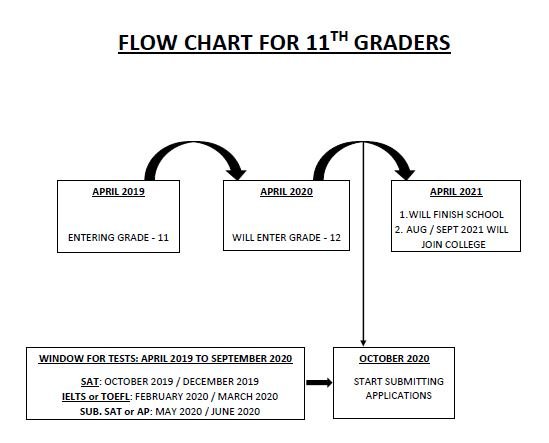
CURRENT SAT TEST STRUCTURE
The current Scholastic Aptitude Test (SAT) Reasoning Test, introduced in March 2016, no longer merits being called the ‘New ‘ SAT. Completely different from the SAT pre 2016, this SAT ushered in major changes in the training styles and philosophies of trainers and training institute, styles that have in 3 years been tried, tested and accepted.
The NEW SAT comprises of three noteworthy segments: The Reading Test is centered around the assessment of students’ comprehension and reasoning skills in relation to appropriately challenging prose passages (sometimes paired, or associated with one or more informational graphics) across a range of content areas, and the Writing and Language Test is centered around the evaluation of students’ revising and editing skills in the context of extended prose passages (sometimes associated with one or more informational graphics) across a range of content areas. The optional Essay is focused on the assessment of students’ skill in developing a coherent and lucid written analysis of a provided source text.
The test covers all mathematical practices, with an accentuation on critical thinking, using appropriate tools strategically, and searching for and making utilization of structure to do algebra. The practices stressed in the redesigned SAT are integral to the requests of postsecondary work. Critical thinking requires students to make sense of problems, to understand issues and continue to tackle them, an aptitude exceptionally evaluated by postsecondary teachers. Modeling stresses applications characteristic of the entire postsecondary curriculum. Students will be asked throughout high school, college, and careers to make choices about which tools to use in solving problems. Finally, structure is primary to algebra and to other more advanced mathematics.
Composition of each section:
Evidence-Based Reading and Writing:
The Reading section has 52 Questions tested in 65 minutes and the Writing section has 44 Questions tested in 35 minutes. Both the reading and the writing are scored together on a scale ranging from 200 -800.The reading and writing will emphasis on words in context, emphasis on command of evidence, inclusion of informational graphics, and specified range of text complexity.
Math:
The raw score, which is the number of correct answers, on the test is converted into a scaled score between 200 and 800 for each section. As there is no negative marking on the test, skipped or wrong questions do not add or subtract from your raw score.
The Math Test has two portions. In the first section, you are given 55 minutes to complete 38 questions wherein calculators are permitted. This section of the test includes questions that involve more multifaceted mathematical approach. So, using a calculator would give you a chance to work more efficiently. Some problems, however, might be easier to solve without a calculator. So, it will be up to you to decide whether or not to use one.
The subsequent portion of the Math Test contains 20 questions, and 25 minutes will be allotted to complete it. Here, the test of your fluency with individual topics and concepts is the focus. Calculators are not permitted on this section, which adds a challenge to the exam. Multiple-choice forms the major chunk of the examination – around 80 percentage – while the other 20% are gridded response, which can include non-negative integers, fractions, or decimals. So, if you get a negative answer it is always a good idea to recheck your work. A set of reference formula will be provided at the beginning of the test. You may find these facts and formulas helpful as you answer some of the questions, but depending on them alone without having sufficient practice would not bring out good results as it slows you down. To do well, you should make sure you are already comfortable using them.
The Math test emphases on three main areas: Questions from the area we call “Heart of Algebra” necessitate you to create, manipulate, and solve algebraic equations. The next area is Problem Solving and Data Analysis, which examines your ability to use percentages, proportions, and ratios appropriately to solve problems in real-world situations, as well as to construe logic out from graphs and tables. The third area, which is the Passport to Advanced Math, involves questions that need you to demonstrate an acquaintance with more complex equations or functions. These are math skills you will want to master if you want to pursue a career in science, technology, engineering, or math.
On the Math test, there are a small number of questions that fall outside of the three main areas. These questions, collectively classified as ‘Additional Topics in Math’, will focus on certain key concepts, including area and volume, coordinate geometry, and basic trigonometry.
The total score for the new SAT is between 400-1600 with a 50 minute optional essay. The redesigned SAT will report multiple sub scores for Reading, Writing and Language, and Math. The Reading and Writing and Language Tests will contribute questions to two sub scores: (1) Command of Evidence and (2) Words in Context. The Writing and Language Test will also report two additional sub scores: (1) Expression of Ideas and (2) Standard English Conventions. The Math Test will report three sub scores: (1) Heart of Algebra, (2) Problem Solving and Data Analysis, and (3) Passport to Advanced Math.
The big takeaways in the new SAT are that you have fewer sections, more time on average per question and the essay is optional. Moreover, there is no penalty in the new SAT, so this relieves the students from the fear of making guesses.

Plan - RED
Weekday Group Course (MWF/TTS)
Weekend Group Course (Friday & Saturday)
+ 26 hrs Math training

The Blue plan allows students to set the pace of the prep course as per the number of classes they take per week.
Test Features
Advantages of studying SAT Course at The Erudite Architects Jaipur
- Guaranteed score enhancement.
- Intensive and very effective training tailor-made for each student.
- The most flexible platform! An array of batch timings ensures that students do not miss anything!
- Experience of training over 1000 school seniors.
- Join a league of successful students!
- Tests are evaluated by our team and the student is invited for problem-solving sessions.
- More than 300 Questions of each type are solved and explained in order to build up a large fund of resource skill.
- Mock tests are the final step in the prep!
| S.No. | Name | Score | TOEFL/IELTS Score | School | Admission Offers | Scholarships |
|---|---|---|---|---|---|---|
| 1 | Labhya Mehta | 1500 | 8.0/9.0 | International Baccalaureate |
| |
| 2 | Jayesh Choudhary | NA | waived | BVB Vidyashram |
|
|
| 3 | Arsheya Mathur | NA | 7.5/9.0 | MGD |
|
|
| 4 | Anushka Sharma (MSci Psychology) | 1230 | 7.0/9.0 | International Baccalaureate (NMS) |
| |
| 5 | Kunal Singh Chauhan(BS Computer Science) | 1430 | 8.0/9.0 | CBSE (JPHS) |
|
|
| 6 | Snigdha Goel (BS Computer Science) | 1460 | 110 | International Baccalaureate (JPIS) |
|
|
| 7 | Suyash Vishnoi (BS Environmental Science) | 1420 | 101/120 | CBSE (MSMSV) |
| |
| 8 | Jahnvi Hariani (BS Varied ) | 1480 | 116 | CBSE (MSMSV) |
| |
| 9 | Harshvardhan Pareek | 1300 | 7.5/9.0 | CBSE (MSMSV) |
| |
| 10 | Sudhiksha Kaushik | 1450 | 8.0/9.0 | CBSE (MSMSV) |
|
|
| 11 | Divyansh Kotawala | 1350 | 107 | CBSE (MSMSV) |
| |
| 12 | Arihant Mittal | 1250 | 7.0/9.0 | CBSE (MSMSV) |
|
|

Get Expert Guidance
Fulfill your dream of studying abroad through premium guidance tailored to your profile from a team of global experts who make education in top-tier colleges accessible and affordable.